
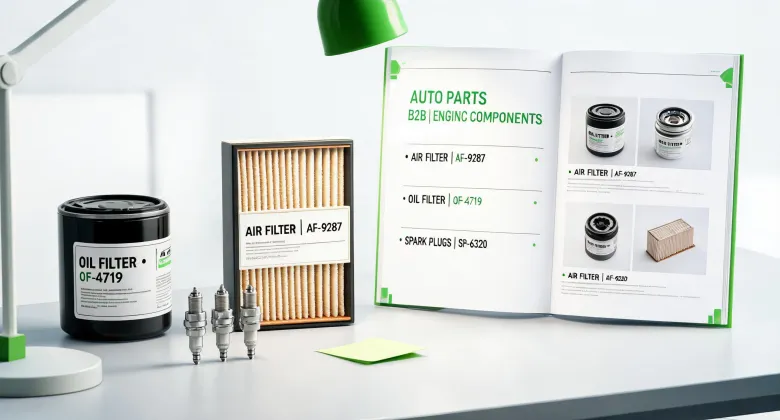
The quickest way to find a Mahle F7572 catalytic converter gasket isn't by price-shopping—it's by trusting an official source.
I've learned this the hard way, more than once. Early in 2022, I was sourcing parts for a fleet maintenance project. We needed a specific gasket—a Mahle F7572 catalytic converter gasket—and I figured I could save a few bucks by hunting around. I spent about six hours across three days cross-referencing part numbers from different suppliers. I ended up saving $12 per gasket. The downside? Two of the parts arrived with the wrong internal diameter. The rest showed up on different days. I spent another two hours on the phone sorting returns. My shop foreman was not thrilled. In my opinion, that $12 saving on a critical part was absolutely not worth the headache.
Why this matters for your workflow
Look, I manage purchasing for a mid-sized service company. We're not a massive dealership, but we process around 60-80 parts orders annually for our fleet and facility equipment. When I took over purchasing in 2020, I thought the game was all about getting the lowest price on a pf61e oil filter fits what vehicle application or finding the cheapest crv tail light assembly. I've shifted my thinking a lot since then.
It took me about three years and roughly 200 orders to understand that the vendor who provides the most accurate, searchable information is often more valuable than the one with the lowest price. The most frustrating part of sourcing parts like the Mahle F7572 gasket: you can spend 20 minutes on a generic parts site and find a 'compatible' part for $18. You can go to an official channel and pay $28. But the $18 part might not fit. It might show up in a generic box with no spec sheet. That uncertainty, for me, is a killer.
The 'Is it real?' check
When I go to the mahle official website or a trusted distributor, I get certain things automatically. I get a clear part number. I get a spec sheet. I get a known lead time. (Not that I've ever had a perfectly accurate lead time—but at least it's a starting point.) When I buy from a random reseller to save a few bucks on a kia soul oil filter, I'm often trading that clarity for a gamble.
To be fair, some aftermarket parts are fantastic. But when I'm up against a deadline—like needing a crv tail light before a customer safety inspection—I don't want to gamble. I'll pay the 'Mahle tax' for the peace of mind that the part number I ordered is the part I'll receive.
How I weigh the cost of uncertainty
After the third late delivery from a non-OEM distributor, I was ready to give up on them entirely. What finally helped me was building a simple mental model for decisions. I ask myself: "What happens if this part is wrong?"
If the answer is "I reorder and wait two days," I might take the cheap route. But if the answer is "I lose a day of labor for a technician" or "I have to explain to my boss why the truck is down," I go straight for the more certain source. The time I waste scrambling for a replacement is more expensive than the 20-30% premium I paid for a part sourced through an official channel.
A practical example from last month
We needed a Mahle F7572 catalytic converter gasket for a scheduled repair. The job was booked for a Tuesday. I had a guy on the phone offering a 'Mahle-compatible' gasket for $14, which was a solid 40% cheaper than the Mahle official part. I almost bit. But then I remembered the pain from 2022. I went with the official source for $22. Was it worth $8? Absolutely. The part arrived Monday, it fit perfectly, and the job was done on time. More importantly, I didn't spend Friday afternoon frantically calling suppliers. That time saved is worth more than the $8 I 'lost.'
But here's where my logic breaks down
I have mixed feelings about always defaulting to the premium source. On one hand, it's saved me time and headaches. On the other hand, I know I've overpaid for simple things like an oil filter. A pf61e oil filter fits what vehicle question is easy—it's a common filter. I can buy a quality Wix or Fram filter for half the price of an OEM part and sleep well. The key is knowing when to apply which rule.
Maybe I'm wrong. I've never fully understood why the price gap for a simple kia soul oil filter can be so huge between brands. My best guess is it comes down to marketing and warranty coverage. If someone has a solid take on that, I'd love to hear it. But for now, my rule is: for complex or unique parts (like a specific gasket), go official. For standard consumables (like common oil filters), the aftermarket is often perfectly fine.
"Part of me wants to consolidate to one vendor for simplicity. Another part knows that redundancy saved us during that supply chain crisis. I compromise with a primary + backup system."
So, the bottom line? If you're fighting a deadline and need a Mahle F7572 gasket, don't mess around. Go straight to the mahle official website or a known Tier 1 distributor. Pay the premium for the certainty. Your shop foreman will thank you.