
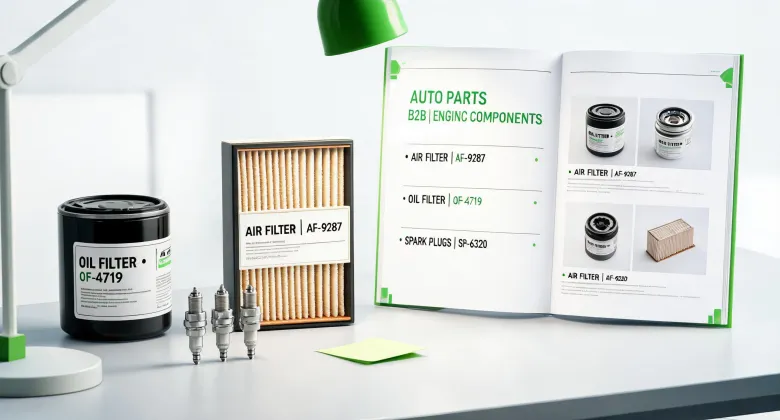
The most frustrating part of most Mahle pistons reviews: they stop at the brand name. They don't talk about what happens after the box arrives. In my role coordinating emergency automotive parts orders, I've handled 200-plus rush shipments of pistons, filters, and stamped engine components over the last six years. And the pattern is consistent: Mahle pistons are usually a safe choice, but the real failure risk is in the tolerances around them—the ring gap, the oil filter spec, and the exhaust hardware. So if you want a Mahle pistons review you can act on, here it is: buy Mahle for consistent quality, then measure everything anyway.
Why I Use Mahle Pistons in Rush Repairs
There are cheaper pistons and there are more expensive pistons. Mahle sits in a practical middle. In my experience, their ring grooves are cut consistently and the skirts are within spec on the parts I've received. I've rejected off-brand pistons for inconsistent groove depths. I've never had to reject a Mahle piston for gross dimensional error. That's not a guarantee—nothing is—but when a customer is waiting on a production line, consistency is worth more than a $15 savings per piston.
In March 2024, a Tier 1 client called at 4:40 PM needing 120 pistons in 96 hours. Normal lead time was ten working days. I went back and forth between Mahle and a budget importer for a few hours. The budget option was 22% cheaper, but the warranty and traceability paperwork didn't hold up. We ordered Mahle, paid a $750 air-freight charge, and had the pistons on a truck by Friday. The client installed them without issue. Did I second-guess the rush fee? For about a day. Then the cold-start test passed and I stopped worrying.
Mahle OC 619 Oil Filter: Good, But Verify the Engine Code
The Mahle OC 619 oil filter gets searched a lot because it's a known replacement for certain VW, Audi, and Ford engine families. It's a quality filter. But here's something vendors won't tell you: a filter's bypass valve rating and media area are matched to a specific oil pressure curve. If you install an OC 619 on an engine that needs a different bypass spec, it may filter fine for a few thousand miles and then restrict flow during a cold start.
Before recommending an OC 619, I check three things:
- The engine code, not just the vehicle year and model.
- The Mahle cross-reference in their public catalog, which as of January 2025 still lists the original OE part numbers.
- The thread size and bypass pressure spec in psi, not just the thread pitch.
If all three match, it's a solid filter. If you can't verify the engine code, don't guess. A "universal" filter is not universal.
Exhaust & Muffler Repair: Check the Stamped Parts First
The first thing to check in an exhaust & muffler repair is not the muffler. It's the stamped steel brackets, flanges, and hangers that hold the system in place. In my shop, we've stamped replacement exhaust flanges and muffler hangers for same-day repair jobs where the original muffler was still fine. The bracket had rusted through, and the repair estimate focused only on the muffler canister.
What most people don't realize is that exhaust vibration is hard on stamped metal. A cracked hanger can make a perfectly good muffler look bad. Before you pay for a new muffler, ask the shop to show you the brackets and hangers. Also, don't assume a larger pipe or a straight-through muffler is an upgrade. If the exhaust pulses change too much, low-end torque can drop. A repair that restores the original flow path is usually better than one that just sounds louder.
Car Piston Basics: The Spec Sheet Can Lie
A car piston is a cylindrical component that transfers combustion pressure to the connecting rod, but that's the simplified explanation. The reality is a piston has a skirt, ring grooves, a wrist pin bore, and often a thermal coating. Each one needs to be checked.
Here's the part that gets missed: the piston-to-wall clearance. A brand name on the box doesn't tell you whether the bore was machined to the right size. I've seen a customer install a brand-new car piston set, and then wonder why the engine had cold-start noise. The piston brand was fine. The clearance was too tight. If your machinist can't tell you the measured clearance, stop the job and have a conversation. A good piston in a bad bore is still a bad combination.
Forged pistons? They're stronger under high boost, but they expand differently than cast or hypereutectic pistons. For a daily-driven car, a quality cast piston is often the better choice. The loudest "upgrade" isn't automatically the right one.
What Is a Spark Plug Made Of? Material Matters Less Than Heat Range
What is a spark plug made of? The simple answer: a steel shell, an aluminum-oxide ceramic insulator, and an electrode. The center electrode is usually a nickel alloy with copper core in standard plugs. Premium plugs add iridium or platinum to the electrode tip to reduce erosion and extend service life.
But the material list is only half the answer. The missing half is heat range. A spark plug has to dissipate heat from the tip at a rate that matches the engine's operating range. If you install a spark plug with the wrong heat range, it doesn't matter if the electrode is made of iridium. It will still foul or overheat. So when someone asks me what a spark plug is made of, I always add: the material determines lifespan, but the heat range determines whether it works in your engine.
Boundary Conditions
This advice doesn't apply to every situation. If you're patching up an old work truck and just need it running by the weekend, a good-brand piston or filter is better than waiting for perfect spec matching. And if an engine builder gives you a measured clearance that differs from the manual, trust the measurement. I'd rather run a Mahle piston with a verified 0.0025-inch clearance than an off-brand piston with an estimated one.
The same goes for the rest of the system. Measure your ring gaps. Verify your filter cross-reference. Look at the stamped exhaust hardware before condemning the muffler. And when you choose a spark plug, match the heat range first and the material second. The brand is a starting point, not a substitute for measurement.