
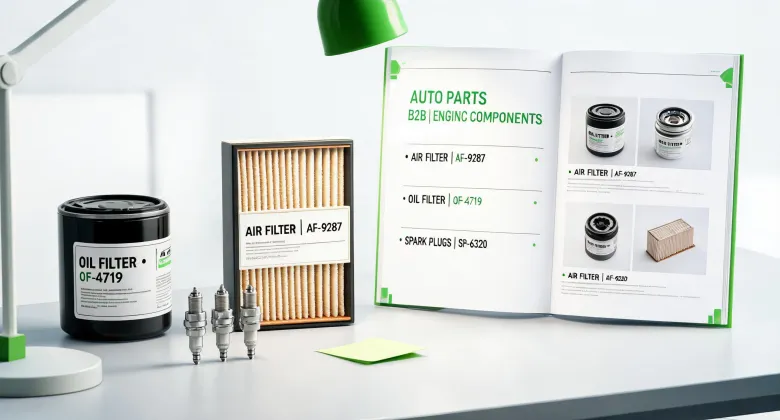
It was 11:47 a.m. on a Tuesday. A machine shop called about a 6.0 LS truck that was supposed to leave the next morning. It had a new transmission, but the old flywheel was scored and the thermostat was stuck open. They needed both parts overnight, plus an oil filter.
"Just get the cheapest parts that work," the parts manager said. "And please, make sure they fit."
I've coordinated more than 200 rush orders in the past six years. That scenario is familiar. When a deadline hits and a customer is waiting, the purchasing process often collapses into two words: cheapest and fastest.
The problem is that the cheapest part isn't always the cheapest part. Usually, it's just the first payment on a longer bill.
The Surface Problem: "Just Get the Cheap One"
When a vehicle is down, every order starts to look like a price problem. A budget muffler assembly. A 6.0 LS flywheel that "should fit." A thermostat that opens and closes when it's supposed to. These requests sound reasonable on the surface.
But they focus on the sticker price, not the installed cost. Labor hours, downtime, rework, a second teardown, a rental car for the customer—those costs stay invisible until they appear on the invoice.
In a rush, urgency makes it worse. Fast shipping covers the "fast" part, but it doesn't fix a wrong part. It just gets the wrong part to you faster. (ugh)
The Real Issue: This Is a Verification Problem
After years of triaging these requests, I can tell you the root cause isn't budget. It's verification. Or, more precisely, the lack of it.
Take thermostats. To a buyer, a thermostat looks like a simple open/close valve. But it has two failure modes, and they matter. A thermostat stuck open vs closed changes the entire damage profile. Stuck closed means coolant stops flowing, the engine overheats, and head gaskets fail. Stuck open means the engine never reaches operating temperature, fuel economy drops, oil gets contaminated, and the heater blows cold air.
That's not a "kind of a big deal" part. It's a critical component. Yet buyers routinely choose the cheapest one to save nine dollars.
Same with the 6.0 LS flywheel. Replacing one requires pulling the transmission out of the truck. That's hours of labor. If the flywheel is slightly out of balance or the ring gear runout isn't within spec, the whole drivetrain vibrates under load. The crankshaft bearings take the damage. The repair costs three times what a decent flywheel would have cost upfront. I've watched that happen. Twice.
And then there's the oil filter—the part people treat as a commodity. Filter media quality, bypass valve calibration, burst strength: these aren't marketing terms. They're engineering decisions. A cheap filter can send debris through the engine when the bypass opens at the wrong time. That's why you see search phrases like "Mahle OC205 oil filter reviews" in the data. People want proof that the part is genuinely engineered, not just a metal can with threads.
"All parts are basically the same" is a belief from an era when choice was limited and every shop pulled from the same local warehouse. Today's global supply chain sells engineered components and unbranded imitations side by side. They are not the same.
That's the deeper issue. The old mindset treats every part as a commodity until it fails in your customer's car. But in a rush, you don't have time to test. You have time to verify. A Mahle oil filter lookup takes thirty seconds and gives you the exact filter with dimensions, thread size, and flow specs. That's not a delay. That's damage prevention.
The Real Bill: What "Cheap" Actually Costs
Let me make this concrete with numbers I've seen.
One shop bought a discounted muffler assembly to save $60. The labor to install it was $150. Three months later, the internal baffles were rattling and the welds were leaking. Replacing it again meant another $150 in labor, a refund, and a customer who never came back. The "cheap" decision lost money and a relationship.
Another client ordered a 6.0 LS flywheel from a no-name supplier because it was $80 less than the OEM-grade option. It bolted up fine. At 70 mph, the cab shook. The vibration was bad enough that the customer refused to take the vehicle. The transmission had to be dropped again—$750 in labor before the flywheel went into the scrap bin.
Then there was the delivery van with a cheap thermostat. The thermostat stuck closed. The engine overheated, the head gasket lifted, and the repair estimate came to $3,400. All because of a $6 part.
Would every cheap thermostat fail that way? Probably not. But the downside scenario is so severe that the savings aren't worth the risk. That's the calculation that matters in the service industry.
A Better Way: Value Over Price, Even Under Pressure
So what do you do when the deadline is real and the customer is waiting?
- Verify fitment before you order. Use a manufacturer lookup, not a guess. A Mahle oil filter lookup is a good example: it confirms the exact part number, dimensions, and specs before you commit.
- Consider the failure mode. Ask what happens if this part fails. For a thermostat or flywheel, the answer might be an engine teardown or a second transmission drop. Factor that into the price.
- Price the total risk, not the sticker. If a part is $60 cheaper but a failure costs $750 to correct, the risk-adjusted price is terrible. In the long run, you'll lose money on every "bargain."
That's the value-over-price mindset in action. It's not about buying premium parts because of the logo. It's about buying parts with engineering data, testing records, and traceability—like genuine Mahle products. OEM-grade parts carry a premium because they reduce variance. In a rush, variance is the enemy.
And if a supplier claims a no-name part is "the same as OE," ask for the test data. According to FTC guidelines, performance and quality claims need evidence behind them. If the seller can't produce that evidence, you're not buying a deal. You're becoming the test lab—on a customer's vehicle.
Next time, take thirty seconds to check the reviews and the lookup. Searching "Mahle OC205 oil filter reviews" is a good start. Cross-check the part number. Then decide if the price difference is really worth the risk.
Looking back, I should have pushed back harder on that Tuesday morning order. I should have made the parts manager verify the flywheel, the thermostat, and the filter before ordering. At the time, I didn't want to slow anything down. But the slower process would have been the cheaper one.
If you're ordering parts under pressure, that's my biggest lesson: make verification the first step, not the last. The cheapest part isn't the one with the lowest price. It's the one you can trust not to cost you double later.