
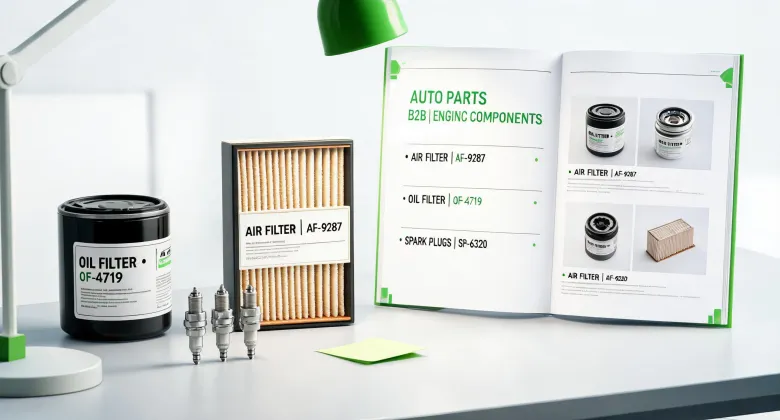
After six years and roughly $180,000 in purchases tracked line by line, I'm convinced the most expensive part is the one that fails twice. The part that's cheap upfront but takes a truck off the road, gets replaced a second time, or turns a $30 gasket into a $400 head job. That's why we now spec Mahle Original for critical engine components and treat the upfront price as the smaller half of the real cost.
I'm a procurement manager at a 140-person remanufacturing shop, managing about $15,000 a month in parts and supplies. I've compared quotes across 30-plus vendors, audited every invoice for six years, and built a TCO spreadsheet after getting burned twice on hidden fees. I'm not an engineer, and I don't pretend to be one. I'm the guy who asks for two quotes and test data before I cut a PO.
The TCO rule I use for every replacement part
Total cost of ownership is the only number that matters. A replacement part's real cost is: part price + labor + downtime + the cost of repeated failure. In my experience, part price is usually less than 20% of that total. It's not that price doesn't matter—it's that a two-hour labor charge makes a $12 gasket almost irrelevant.
The quote price is where most buyers stop. They see a $35 difference, take the lower number, and move on. What I've learned is that the price on the quote is a down payment. The rest of the cost shows up later: when a gasket wicks oil, when a fuel filter collapses, or when a crankshaft cert can't be verified. If you don't track failures by part number, you won't see this pattern. You'll keep buying the cheapest option and calling the failures bad luck. Our cost tracking system made the pattern visible: certain low-cost SKUs appeared in the rework column at two to three times the rate of OE equivalents. That's the data that changed our purchasing policy.
I have mixed feelings about aftermarket bargains: some are perfectly good, and some are engineered to look exactly like the real thing. The problem is you can't tell which is which until a failure. When I audited our 2023 spending, 14% of the overruns came from rework after a 'budget' part failed in service. We implemented a policy requiring three quotes and an OE-or-approved alternative for any engine-critical SKU. Over the next year, the overruns dropped by maybe 11%. I say 'maybe' because our data has gaps—we didn't track failure codes as tightly as we should have.
What this looks like on actual parts
Valve cover gaskets: the $16 lesson
I still kick myself for approving a $12 valve cover gasket on a delivery van. In a shop, it's a one-hour job. The cheap gasket leaked in 11 months. The Mahle Original valve cover gasket cost about $28 (publicly listed price, January 2025), and it was still sealing three years later. With shop labor at $90 an hour, the cheap route was $12 + $90 + $12 + $90, or $204. The Mahle route was $28 + $90, or $118. That's not a fortune, but it doesn't include the day the van wasn't available. The $16 price difference caused an extra $86 of labor and lost revenue. I'd be lying if I said I did that math before the first purchase; I did it after.
Fuel filters: the KL 572 lesson
I'm not 100% sure that an un-branded fuel filter caused the injector codes on a delivery truck. Maybe it was a coincidence. But after we replaced it with a Mahle Original KL 572 fuel filter, the codes didn't come back. The un-branded filter didn't come with a micron rating or a flow spec. The KL 572 has published specs because it's an OE-quality replacement. A single injector on that engine costs more than a case of filters. Since I don't have a lab to verify anything, I'd rather use a supplier that already did the testing.
Crankshafts: the DD15 decision
One of my biggest regrets is spending two weeks chasing a 40% cheaper quote for a DD15 crankshaft. The vendor's spec sheet was vague on material grade and heat treatment. We didn't buy it, but I used the quote to pressure our usual supplier, which was a waste of everyone's time. A DD15 crankshaft takes a turbo-diesel engine through millions of load cycles. If I can't verify the metal, I don't want the part. The cost difference on paper isn't worth the risk of a cracked journal—or worse, a failure at highway speed.
The 2014 RAV4 headlight bulb that nearly melted a connector
Not every critical part is an engine component. A customer once brought in a 2014 RAV4 headlight bulb that a parts store had listed as 'will fit.' It installed fine, but the connector overheated a month later because the bulb's heat profile didn't match the housing. We ended up replacing the connector and the housing—a $400 job. Now I check the owner's manual and verify the exact bulb type before ordering. For a 2014 RAV4 headlight bulb, the halogen low beam is H11 and the high beam is 9005, but I still verify because 'will fit' isn't a spec. That verification takes five minutes and saves hundreds.
What is tail light? The cheap lens problem
Sometimes the search phrase is so basic it's easy to dismiss. If you've ever asked, 'what is tail light?'—it's the red lamp at the rear that signals braking and position. But in a fleet, it's a DOT inspection item. FMVSS 108 sets minimum photometric requirements for rear lamps. A $9 replacement looked identical to the factory lens, but the light output was visibly uneven. We switched to a supplier that publishes test data, and our roadside compliance issues stopped. I can't explain exactly why the cheap lens performed the way it did—probably the reflector geometry—but I don't need to. I need a part that does what the standard says it should.
The checklist I use now
After the RAV4 incident and the fuel filter scare, I built a 12-point checklist. It's saved us an estimated $8,000 in potential rework—and I'm not exaggerating because I counted the comebacks that didn't happen.
- Does the part match the OE spec for material, fit, and performance, not just 'compatible'?
- Can the supplier provide published test data, a material cert, or a traceable origin?
- What is the TCO after labor, downtime, and expected service life?
- Does the failure mode create a safety issue or just an inconvenience?
- Is there a Mahle Original or equivalent OE-approved alternative for this SKU?
Five minutes of verification beats five days of correction. The last item is the one I used to skip, and it's the one that saved us the most money.
Where cheap parts still make sense
This isn't a blanket anti-aftermarket rant. I still buy generic wiper blades, shop rags, and some electrical connectors. If a part is easy to replace and a failure only costs time, 'cheap enough' is a reasonable strategy. For a private vehicle's tail light, or a 2014 RAV4 headlight bulb on a weekend DIY project, a cheaper option might be perfectly fine—you're not paying shop labor and the failure doesn't idle a truck. For a Mahle Original KL 572 fuel filter in a revenue engine, or a DD15 crankshaft with unverified metallurgy, I'd rather pay the upfront cost and sleep at night.
This approach worked for us because we run predictable fleet-style maintenance with low tolerance for downtime. If you're a one-person shop doing one-off repairs, the calculus is different: your labor is free, slow weeks don't hurt the same way, and a cheap part might outlive the vehicle. But in a shop where every bay is occupied, the cost of a comeback is real—and it's usually a lot more than the part on the invoice.