
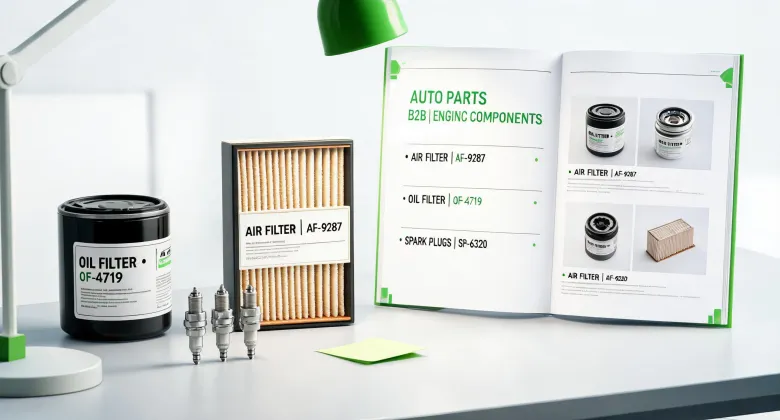
If you're looking up a Corvette C4 fuel pump, a Mahle KL145 fuel filter, or a catalytic converter replacement, start here: the cheapest part is usually the most expensive part. I know that sounds like a slogan. It's not. It's the conclusion from six years of tracking invoices, failures, and labor hours in an independent shop.
I'm the procurement manager at a 12-person automotive repair and small-fleet service center. I've managed a parts budget of about $180,000 a year for six years, negotiated with more than 40 vendors, and logged every order in our cost tracking system. If there's one thing the data has hammered into me, it's this: don't compare price tags. Compare total cost. Price is what you pay. Cost is what you live with.
Total cost: the only number that matters
When I audited our 2023 spending, the same pattern showed up every quarter. We bought a cheaper part to save money. The part failed. We re-diagnosed, re-installed, apologized to the customer, and absorbed the labor. The “savings” disappeared. In Q2 2024, I compared eight oil filter suppliers over three months using our TCO spreadsheet. The cheapest filter was $2.10 less per unit than the Mahle oil filter we eventually standardized on. Over 600 filters, that looked like $1,260 of savings. But the cheap filter had a failure rate of 1.1%. The Mahle filter failed at 0.1% in the same tracking period. Six extra come-backs at roughly $65/hour in lost labor ate the entire $1,260. Then some.
Three numbers tell me more than any unit price: part price, expected service life, and total labor hours if it fails. In that order. Or, to put it plainly: do the job twice and see what “cheap” really costs.
I built that spreadsheet after getting burned on hidden fees twice. Once by a supplier who charged a “core fee” on a part that didn't have a core. Once by a no-name converter that didn't come with the right mounting adapter. Both mistakes are still in my invoice logs. That's why I'm not preachy about brand names. I'm preachy about math.
The fuel filter that stopped a van
Fuel filters are easy to ignore because they don't make noise. But they sit between the tank and the injection system, and a collapsed filter can leave a driver stranded.
We once bought a batch of generic filters for a delivery fleet because the fleet manager wanted to save money. Against the Mahle KL145 fuel filter, which matched the OEM part number, the generic saved about $2.15 per filter. Small. Good deal, I thought. I was wrong.
A week later, one of the vans wouldn't start on a cold morning. Fuel pressure was low because the filter media inside the generic unit had collapsed. Tow truck, lost route time, driver sitting around. The surprise wasn't the price difference. It was how much hidden cost came with the cheap option—tow, labor, and a customer who stopped trusting us.
We switched the whole fleet to the Mahle KL145 after that. Not because of the brand decal. Because the spec and the build quality were consistent. The generic filter looked fine in the box. It didn't perform fine under pressure. Simple.
(Note to self: check the warranty fine print before approving a budget alternative. Some “savings” aren't worth the paperwork.)
Corvette C4 fuel pump: a $75 gap becomes a $450 bill
Then there was the Corvette C4 fuel pump. The customer wanted the cheapest option. The budget pump was $85. The correct replacement was $160. I told him the cheap one wasn't the same spec and that fuel pumps are labor-heavy. He said try it.
Installation took about 2.5 hours. One week later, the car came back on a flatbed. Low fuel pressure. We pulled the pump again and replaced it with the correct unit. Parts cost: $160. Extra labor: about 3 hours. Add the tow and our time, and the customer's $75 “savings” turned into roughly $450 of avoidable cost. The price difference was small. The cost of doing the job twice was not.
That's the rule for anything buried near the fuel tank: if the part could strand the vehicle, buy the spec, not the deal.
How much to fix a catalytic converter? Get the diagnosis first
Let's handle the question everyone asks: how much to fix a catalytic converter? As of early 2025, national repair estimators typically put a replacement between $1,500 and $2,500 for parts and labor on most vehicles. But a converter often isn't the real problem.
We saw a car with a P0420 code. The owner had been quoted $1,800 for a new converter at another shop. Our tech checked the O2 sensor data, found the rear sensor was slow, replaced it for about $140, cleared the code. The converter was fine. The $1,800 quote was for a part the car didn't need.
That's the transparency issue in this industry. A shop that tells you the part price without showing you the diagnosis is guessing with your wallet. Before you ask what a converter costs, ask what proof they have that the converter is bad. Look at fuel trims, verify the O2 sensors, watch the live data. Then decide.
Also, a universal converter is cheaper until you add the welding time and the adapter issues. A direct-fit unit often costs more in the box and less on the lift. Same math as everything else.
Air filters: “filter air” and the $5 insurance policy
Air filters seem too simple to cause trouble. When someone searches “filter air,” they usually want the cheapest one that fits. But a filter that flows too much lets dirt through. A filter that's too dense chokes the engine. Both are worse than spending an extra $5 on an OEM-spec filter.
For most vehicles, a quality air filter costs less than $25 and takes five minutes to change. Over 20,000 miles, that's basically free insurance. A cheap filter that lets particles past can foul the MAF sensor and coat the intake, leading to a $300+ cleaning job. The cost is hidden in the future. I've seen it happen. It's not rare.
When cheap actually makes sense
Now the honest part: cheap parts aren't always wrong. If you're selling the vehicle in six months, if the part isn't safety-critical, or if labor is covered under warranty, price might dominate. I buy economy wiper blades for loaner cars. I don't buy economy oil filters, timing belts, fuel pumps, or converters. There's a difference between a commodity part and a trust part.
And brand isn't magic either. A Mahle part still has to fit the application. I check the OEM cross-reference every time. What separates a good supplier from a bad one is transparency: the spec sheet, the warranty terms, and the willingness to answer questions before you order. If a supplier can't explain what's included, I assume there are hidden costs.
In automotive manufacturing, suppliers to assembly lines are held to IATF 16949 quality system requirements. That's the kind of rigor I want behind the parts I put into customer cars. Not because the box has a recognizable logo, but because someone checked the process.
Bottom line
So don't ask which part is cheapest. Ask which part is cheapest to own. That's a different question—and it's the one that saves the real money.