
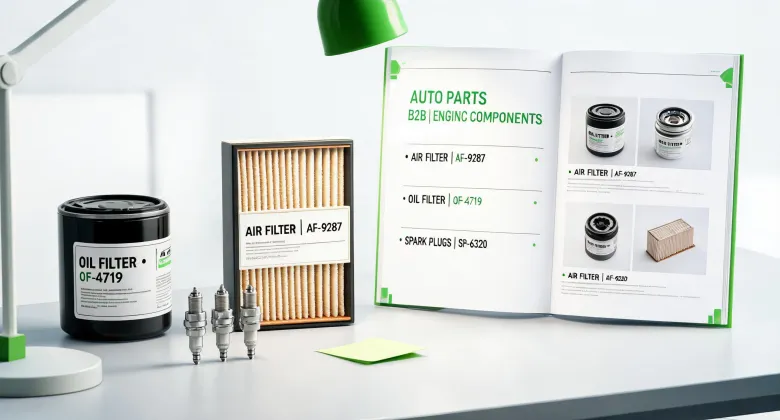
After tracking 1,247 parts orders over six years, the most expensive gasket mistake I've seen didn't come from a bad MAHLE N55 valve cover or a leaking Fel-Pro gasket. It came from treating 'same part number' as 'same part.' In 2024, that assumption cost our shop roughly $7,300 in rework and lost bay time. The fix has nothing to do with brand loyalty—it's verifying the full assembly spec before you order.
If you're searching 'mahle vs felpro gaskets,' here's the short version: both brands make gaskets I'd put in an engine. The question is which one matches that engine's sealing surface, temperature range, and torque procedure—and whether you're buying a complete kit or a single part.
Why I started tracking every parts order
I'm the procurement manager at a 55-person powertrain shop. I've managed a parts budget of about $620,000 a year for six years, negotiated with 30-plus vendors, and logged every order in a TCO spreadsheet. 'TCO' meaning total cost of ownership—not just the unit price, but shipping, labor, rework risk, and the value of a customer's trust.
At first, the spreadsheet was just a way to keep vendors honest. Then it became a failure log: part number, brand, install date, labor hours, root cause. After a couple of years, the pattern was obvious. Price was rarely the deciding factor. Missing components and wrong revisions were.
The first thing I learned is that price differences are often illusions. A gasket at $8.50 versus $14.00 looks like a clear choice. But when labor is $120 an hour, a $5.50 saving is less important than the chance of a comeback. The cost of a failed part is the part, plus the labor, plus the time the bay sits empty, plus the phone call you don't want to answer. (I've filed enough warranty claims to know that last one is real.)
The MAHLE N55 valve cover order that changed my process
One order in Q2 2024: a BMW N55 engine with oil leaking near the valve cover. Customer approved the repair. The system showed a MAHLE N55 valve cover at $162 and an 'equivalent' at $118. I almost picked the $118 one. Actually, no—I was about to pick it, and then I read the catalog note.
The MAHLE cover is supplied as a complete assembly, including the integrated PCV valve and the cover gasket. The $118 equivalent? It didn't list the PCV diaphragm. If we reused the old PCV, we'd save $44 but risk the exact oil consumption and vacuum leak we were trying to fix. The cheaper price would have been the real premium. We bought the MAHLE unit. The job went fine. That's the unglamorous truth: the best cost decision was boring.
I should add that we still use Fel-Pro gaskets on some older engines. In my spreadsheet, Fel-Pro's PermaDryPlus line has performed well on GM engines with slightly pitted sealing surfaces. MAHLE's multi-layer steel gaskets are my preference for late-model forced-induction engines. That's not a brand war; it's material science.
The 'just buy the cheaper gasket' logic comes from an era when engines had wider tolerances and simpler sealing surfaces. That era is gone. Today, a valve cover on an N55 has integrated PCV, small fasteners, and an aluminum head that expands differently than the cover. What was best practice in 2020 may not be best practice in 2025. The fundamentals haven't changed—fit, cleanliness, torque—but the execution has.
The cost of 'equivalent' parts
I learned never to assume 'equivalent' means 'identical' after receiving a batch of 'compatible' timing cover gaskets that didn't line up with the oil pump pickup. The part was probably fine for another engine generation. It was not fine for ours. We spent $1,200 on a redo and a rental car for the customer. The 'budget vendor' choice looked smart until we saw the quality. Net loss: more than the 'expensive' quote.
Is every premium brand part worth it? No. But the difference is usually in the spec sheet, not the logo. When a part has integrated components—like a PCV in a valve cover—the specification is the product.
What 'CV axle for Toyota' and 'proper right turn signal' have in common
When I look at our search query data, I see 'cv axle for Toyota,' 'proper right turn signal,' and 'G2 Original Brake Caliper Paint SystemTM reviews.' At first, those seem like unrelated product searches. But they all share a pattern: people are asking for certainty, not just a product.
'CV axle for Toyota' isn't enough information to order a part. We learned to ask about axle length, spline count, ABS ring teeth, and inner joint type. The same part number might fit a Camry with one transmission code but not another. If you order by vehicle model alone, you're gambling with someone else's time.
'Proper right turn signal' might not need a part at all. It might need a wiring diagram, a flasher relay, or a socket cleaning. If we jump to a part, we've missed the diagnosis. Sometimes the most profitable order is the one we talk the customer out of.
And 'G2 Original Brake Caliper Paint SystemTM reviews'—look, reviews help. But a 4.8-star rating won't tell you whether the paint resists DOT 4 brake fluid, or how much surface prep is required. The technical data sheet will. That's the same lesson, just in consumer form.
How to apply this without overthinking it
I get why people go with the cheapest option. Budgets are real. But hidden costs add up. Before you pick between vendors, ask four questions:
- What's actually in the box? (Complete assembly, gasket, fasteners, small parts?)
- What are the consequences of a failed fit? (Labor, rework, customer trust)
- Does the brand publish a technical spec sheet or catalog note?
- Is the part search a product search or a symptom search?
Those questions would have saved us the $7,300 in rework last year. To be fair, not every part needs this scrutiny. For a simple, single-piece gasket on a low-stress application, the cost of analysis can be higher than the risk. But for a MAHLE N55 valve cover, a CV axle for Toyota, or any part with integrated components, verify before you buy. At least, that's been my experience with late-model German and Japanese engines.
Prices mentioned above are from our January 2025 order records. Verify current part numbers and pricing with your supplier because things change—usually quickly.
If there's one thing I hope you take from this: the brand fight is rarely the real fight. The real fight is between a part number and a spec sheet. That, and the willingness to read the catalog note before you click 'buy.'