
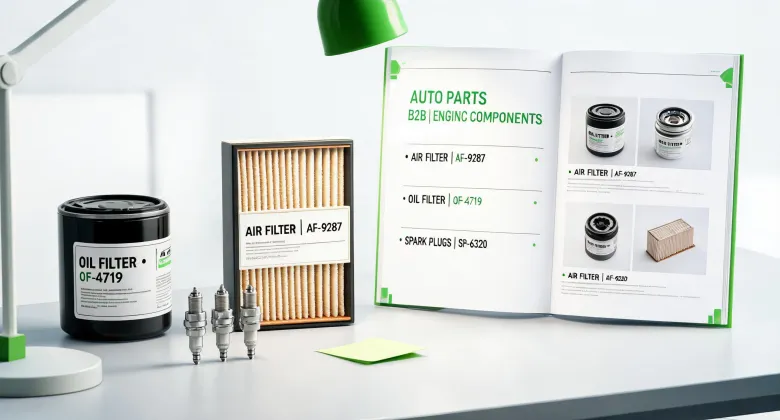
This checklist is for anyone who has to source a Mahle component today—an oil filter, a stamped v strut bracket, a CNC-machined housing—and doesn't have the luxury of finding out later that it's wrong. I coordinate rush orders in automotive parts, and I've handled 40-plus emergency requests in the last two years. Maybe 47, I'd have to check the log. The one thing they all have in common is that someone skipped a differential diagnosis before saying "that should fit."
In medicine, a blanching rash differential diagnosis is the list of conditions that can cause a rash that turns pale under pressure. In auto parts sourcing, the same idea should apply to every part number. If you treat the part number as the symptom instead of the final answer, you avoid the false starts that turn normal orders into emergency orders.
Step 1: Get the Full Build Details Before Comparing Brands
Don't ask "mahle vs mann oil filter" yet. Ask for the engine code, model year, VIN, and the OEM part number. The same car, in different production months, can use a different filter, a different bypass valve, or a different stamped bracket—even when the visual design looks identical.
From the outside, sourcing a filter looks simple. The reality is that a filter's bypass valve pressure, thread size, anti-drainback valve, and gasket dimensions can change between model years. The most expensive question in a machine shop is: "I assumed it was the same."
Step 2: Build the Part-Number Differential Diagnosis
Make a list of plausible part numbers before you buy. Include the OEM number, a Mahle reference, a Mann reference, and aftermarket cross numbers. Then eliminate candidates based on actual specs.
A common search is "ph4967 oil filter fits what vehicle." The short answer is that PH4967 is often the aftermarket crossover for the Mopar 04884889 oil filter used on Chrysler/Dodge/Jeep/Mitsubishi 2.0L and 2.4L engines—including the Dodge Caliber, Jeep Compass, Jeep Patriot, and some Mitsubishi Lancer and Outlander versions. But that is still not enough. The same engine family had variations in bypass pressure and anti-drainback valve specs. Always verify with the engine code and the OEM part number.
Similarly, a "v strut" search can create a false positive. It can mean a V-shaped suspension brace, a stamped reinforcement bracket in a vehicle frame, or a die component in a stamping press. If a customer sends a PO for a "v strut" with no drawing, I stop the clock and ask. That stop is not a delay; it's an investment in not buying the wrong part.
Step 3: Compare Actual Specs, Not Logos
The mahle vs mann oil filter debate is a classic one. My position is simple: both are legitimate OE suppliers. Treat both brands as starting points, not final answers. What matters is whether the filter matches the application.
Compare thread size, bypass valve pressure, anti-drainback valve, and filter media. Filter media matters (which, honestly, is the part people skip when they are comparing brand names). Per FTC guidelines (ftc.gov), a claim that a part "fits" has to be substantiated. In B2B sourcing, that substantiation is the cross-reference, not the logo.
Step 4: Inspect the Physical Part — Especially When the Term Is Vague
In March 2024, 36 hours before a deadline, a Tier 1 customer needed a replacement bracket and a Mahle filter housing. We had the housing. The bracket was a V-strut stamping with no finish specified. I assumed standard E-coat. It wasn't.
We paid $800 for rush finishing and made the line, but the true cost of that "small" assumption was over $2,000 once you add expedited freight and my engineer's evening. Looking back, I should have asked for the drawing the moment I saw the words "v strut." At the time, the V in the name made me think I knew what it was. That was the mistake.
What I should have done, and what I do now, is treat any vague term as a red flag. A real part has a drawing, a material grade, a finish spec, and a dimensional report. If all you have is a product category, you don't have a spec yet.
Step 5: Price the Failure, Not Just the Part
I calculate TCO before comparing any vendor quotes. TCO includes part price, expedited shipping, setup, inspection, rework, downtime, and the cost of explaining to your client why the part doesn't fit.
This is why I don't get excited by a mahle vs mann oil filter headline. If a Mahle filter is $1.50 more than a Mann equivalent, but the Mahle is already in stock and verified for that engine, the Mann filter isn't necessarily cheaper. The lowest quote is rarely the cheapest outcome.
For anything connected to engine lubrication or cooling, I also want an engineering sign-off. That can be internal, or it can mean working with a group like Mahle Powertrain LLC to validate the system behavior. It costs a little and saves a lot. No one can promise zero defects—and anyone who does is not pricing the risk correctly.
Before You Approve Any Order
Use this mini checklist as your last step:
- Do you have the OEM part number or a written specification?
- Have you verified the cross-reference against physical specs, not just a search result?
- Have you checked the date break, engine code, or model year?
- What is the total cost if the part fails—including downtime and expedited replacement?
None of this is glamorous. It's a checklist. But the reason I keep using it is simple: the emergency order that looks like a hero story is usually a TCO failure that someone forgot to price. A blanching rash differential diagnosis, a filter number, or a vague part name—none of it is a final answer. The diagnosis is only as good as the verification behind it.