
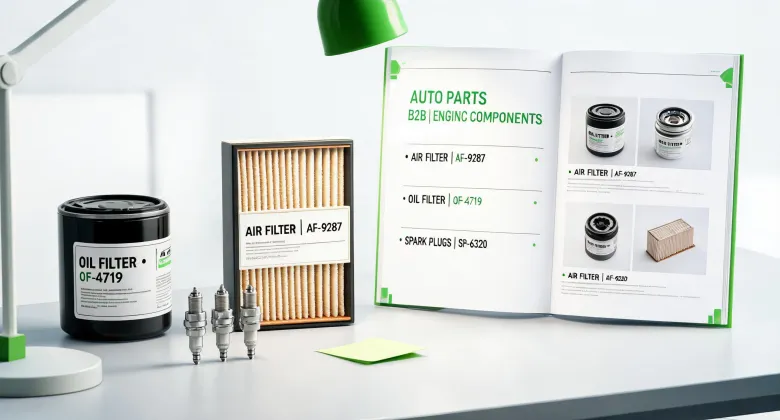
The call came in at 2:14 PM on a Tuesday in March 2024. We had 36 hours before the client's engine pilot line was scheduled to run, and the order wasn't a single part. It was four things: a stamped cover plate, a CNC-machined fixture to hold an N54 crankshaft for a bearing clearance check, a MAHLE Honda oil filter for the test cell, and a piston ring groove cleaner for the teardown station.
I'm an emergency specialist at an automotive stamping company. In my role coordinating rush orders for OEMs and Tier1 suppliers, I've handled 200+ urgent jobs over the past nine years. I've seen a lot of 'impossible' deadlines. This one was different because it forced us to be honest about what we do—and what we don't.
A Phone Call That Started With a Sealed Box
The first thing the client's purchasing manager said was, 'Can you do all of it? We want one supplier.' It's a fair ask. One purchase order, one shipping dock, one invoice. But the four line items didn't belong together. That was the surface illusion.
From the outside, it looks like a rush order just means the vendor works faster. The reality is that a rush order often requires completely different workflows, different equipment, and, in some cases, a different supplier. We could handle the stamped cover plate and the CNC fixture. The oil filter was a distribution question, not a manufacturing question. And the piston ring groove cleaner was not our product line. I said that out loud, and the silence on the other end of the phone was loud enough to hear.
Here's something vendors won't tell you: 'standard turnaround' often includes buffer time that vendors use to manage the production queue. It's not necessarily how long your order takes. But that buffer only exists if the part is actually made on our floor.
The 36-Hour Window
We had 36 hours. For this job, the checklist was simple: geometry confirmed, die changeover scheduled, shipping route locked. In that order. The stamped cover plate was a small progressive die part—not hard for us, but it was already scheduled for a different job. The fixture was more interesting. It had to hold a specific N54 crankshaft at the main journal positions while the QA team checked clearances. That's a machining fixture we could build, but not overnight without bumping other work.
While we were breaking down the work, the client's engineer asked me about something he'd read. 'I saw a MAHLE gaskets review saying these fail in six months. Should we switch?' I told him the same thing I tell every customer: a forum review is not a spec sheet. I don't work on the gasket line directly, but I know enough to ask whether the part number matched the application and whether the fasteners were torqued correctly. Most 'bad gasket' stories I've heard end up being installation mistakes or the wrong part number. He still needed to verify the exact seal, but he at least stopped making a purchase decision from one review.
Then came the question about the oil filter. The request specified a MAHLE Honda oil filter. Easy enough—but only if we had the correct OEM cross-reference. I told the client, 'I can source it, but I won't guess the fitment.' We needed the Honda part number or the MAHLE stock number. He sent it over at hour 6. We had a rush shipment moving by hour 8.
The piston ring groove cleaner was the awkward part. I've used one before: a specialized tool that cleans carbon out of piston ring grooves during an engine rebuild. But using a tool and making one are different things. We make stampings, dies, molds, CNC-machined parts, forgings, and extrusions. We don't make hand-held cleaning tools, and pretending we could would have been a disaster.
So I told the client to call a tooling specialist we've used before. That decision made the rest of the project harder in one way: the generalist they'd also quoted told them they could supply everything, including the cleaner, and would only charge $3,200 for the package (prices as of March 2024; verify current). Our quote for just the two parts we could realistically deliver was $4,100. The purchasing manager had two hours to decide. Normally I'd say get multiple quotes, but there was no time. I made the case as clearly as I could: a vendor who says 'we can do everything' often means 'we can broker everything.'
Look, I'm not saying bundling is always bad. I'm saying a bundle has to be built on actual capability, not a sales rep's willingness to say yes. I'd rather work with a specialist who knows their limits than a generalist who overpromises. That's not a slogan. It's a rule I learned after three failed rush orders with discount vendors in 2022—enough to change our company policy.
Why We Split the Order
He chose to split it. We took the stamped cover and the N54 crankshaft fixture. The oil filter went through our distributor. The piston ring groove cleaner came from the tooling specialist, who, by the way, quoted it at $780 and delivered in 30 hours. I paid $180 extra in courier fees (on top of the $780 base cost), but the client's alternative was a $50,000 penalty clause for missing the pilot run. The math was simple.
Even after confirming the order, I kept second-guessing. What if the fixture's bore tolerances were wrong? What if the gasket review was right and an early failure shut down the test? I hit 'confirm' on the rush fees and immediately thought, did I miss anything? I didn't relax until the QA report came back at hour 35.
There's also a side question that came up during that same call: 'Is the catalytic converter part of the powertrain?' It wasn't from our client; it was from an emissions engineer sitting in the same room. My answer, for what it's worth: a catalytic converter sits in the exhaust system, not in the rotating or reciprocating driveline. For a warranty claim, the classification depends on how the original equipment manufacturer defines 'powertrain.' Some include the exhaust aftertreatment because it's tied to engine management; others draw the line at the flywheel. I'm not a legal expert on regulatory definitions. But I know that pretending to have an official answer without checking the OEM's warranty manual is exactly the kind of overconfidence that costs someone money.
The stamped cover plate came off the press at hour 32, ready after a die changeover. The CNC fixture was machined by hour 34 and verified on a coordinate measuring machine. The oil filter arrived at hour 35. The piston ring groove cleaner was on the bench at hour 30. At hour 36, the pilot line started, and I allowed myself to exhale.
What the Rush Order Taught Me
There's something satisfying about a perfectly executed rush order. After all the stress and coordination, seeing it delivered on time and correct is the payoff. But the lesson from that March afternoon goes beyond 'we met a deadline.'
First, specialization is not a limitation. It's an informed point of view. The vendor who told me 'this isn't our strength—here's who does it better' earned my trust for everything else. So I try to do the same for our customers. When we say a piston ring groove cleaner should come from a tooling specialist, we're not turning away work. We're protecting the project.
Second, don't let a one-stop-shop promise override engineering reality. From the outside, bundling looks efficient. What you don't see is the extra layer of markup, the third-party shipments, and the reduced accountability for the part that wasn't made in-house. Ask about the actual manufacturing floor before you assume that 'all of it' means 'made by them.'
Third, every online review needs an application check. A 'MAHLE gaskets review' that doesn't include the engine code, part number, and torque sequence is just background noise. The same goes for a MAHLE Honda oil filter: the right filter for one Honda engine may be wrong for another, and part numbers exist for a reason. Verify, then trust.
And if you're wondering whether the catalytic converter is part of the powertrain, ask the warranty engineer who will have to pay the claim—not the parts supplier. My job is to be precise about what we make and honest about what we don't. That boundary is part of the service. Per FTC business guidance on advertising (ftc.gov), claims have to be truthful, not misleading, and substantiated. But that standard shouldn't just apply to marketing. It should apply to every conversation about a part you're staking a deadline on.
'The right specialist, used in the right place, is faster than a generalist trying to be everywhere.'
In the end, the client got the cover plate, the fixture, the filter, and the cleaner. The pilot ran. The penalty didn't happen. And the purchasing manager's takeaway, in his words, was simpler than any marketing line. I'll take that.